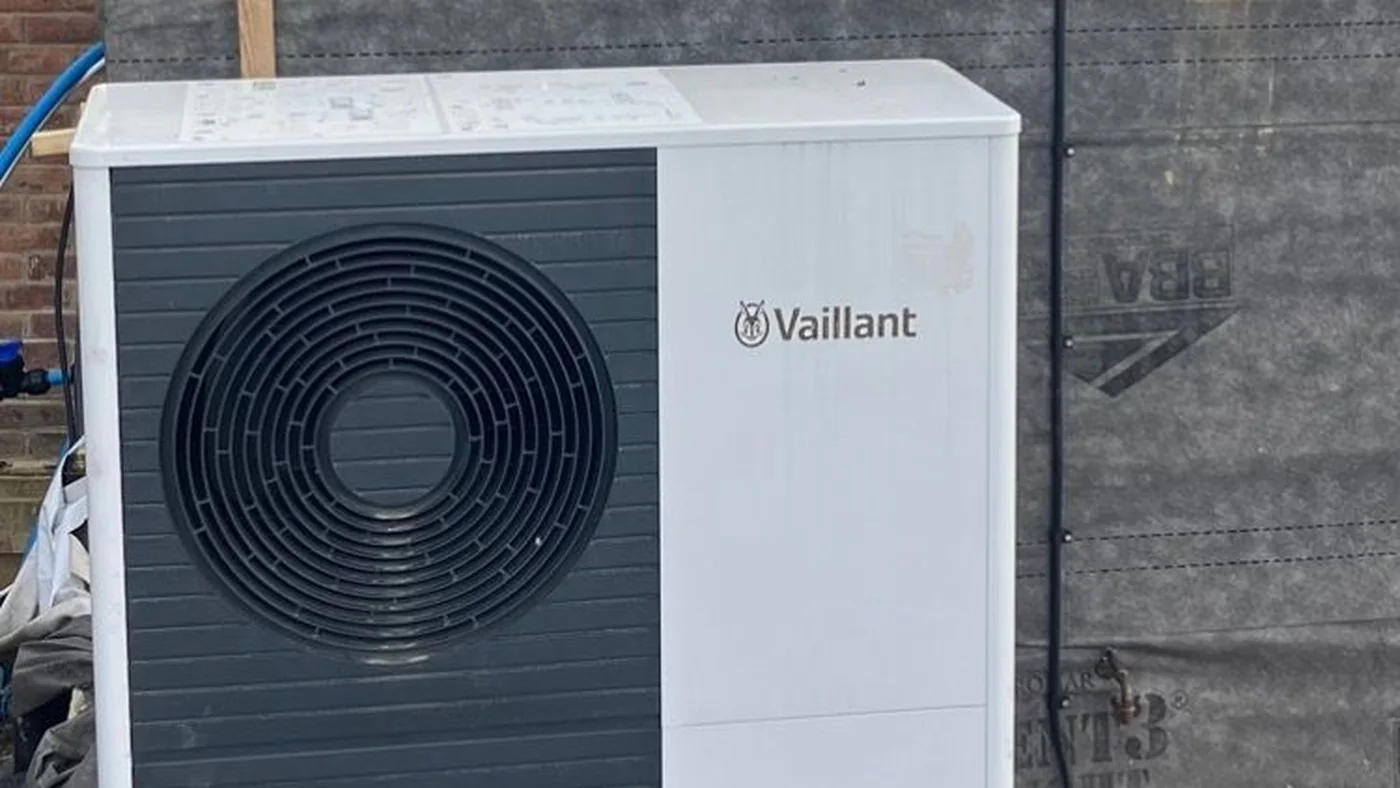
The age of your house is not what decides whether an air source heat pump will work in it. Plenty of Victorian terraces in Bromley run one perfectly well, and plenty of newer houses need work first. What decides it is the heat loss survey.
Dan gets asked this question most weeks, usually phrased as "is my house too old for one?" It is the wrong question. A heat pump does not care how old the brickwork is. It cares how much heat the building loses on a cold day, and whether the radiators or floor circuits you already have can put that much heat back in at a lower temperature. Both of those are measurable, which is why the survey comes before the price.
Why a Heat Pump Is Not a Boiler Swap
A gas boiler makes heat by burning fuel, and it can run the water round your radiators very hot, often at 70 to 80 degrees. That covers up a lot. Undersized radiators still work, because you can simply push the temperature up.
An air source heat pump works differently. It moves heat out of the outside air and into your heating and hot water, and it does that most efficiently at a low flow temperature. The lower the flow temperature, the less electricity it uses for the same warmth. That is the whole point of the technology, and it is also the reason the system around the unit has to be designed rather than simply connected up.
- Lower flow temperature: the water going round the house is cooler than a boiler would send it, so every emitter has to give out the same heat at a lower temperature.
- Longer, steadier run times: a heat pump is happiest running gently for long periods rather than blasting on and off, so controls and weather compensation are set up differently.
- Hot water is stored: a cylinder sized for the household replaces instant hot water from a combi, so cylinder space has to be found and the coil has to suit a heat pump.
- The design is the job: most heat pumps that disappoint people were fitted as a like-for-like swap without any of the above being worked out first.
The Heat Loss Survey Decides It
Every installation Aspie Plumbing & Heating Ltd takes on starts with a room-by-room heat loss survey. It is a calculation, not a guess. Dan measures the rooms, records the construction, the glazing, the insulation and the ventilation, and works out how much heat each room loses on a design day.
That one document then answers almost every question people arrive with:
- What size unit you need: sized to the house, not rounded up out of caution. An oversized heat pump costs more to buy and runs less efficiently.
- Which emitters have to change: the survey names the specific radiators that are too small at a lower flow temperature and the ones that are already fine.
- What cylinder is required: based on how many people live there and how they actually use hot water.
- Whether it is worth doing at all: if the numbers say the property needs significant fabric work first, you get told that before you spend anything.
This is also why heat pump pricing on our air source heat pump page is quoted after the survey rather than shown as a headline figure. Quoting a heat pump without the survey is how people end up with a system that does not heat the house.
Want to Know if Your Home Suits a Heat Pump?
Call Dan on 07748 945795. Every heat pump quote starts with a full room-by-room heat loss survey across Bromley, Chislehurst, Bexley and Sevenoaks.
Call for a SurveyDo You Need New Radiators?
Sometimes, but not always, and the difference matters because radiators are usually the part people fear most.
A radiator gives out heat in proportion to how much hotter it is than the room. Drop the flow temperature and the same radiator gives out less. So each one has to be big enough to deliver its room's heat loss at the lower temperature the heat pump will run at. In practice that splits a typical house into three groups.
- Already fine: rooms that were over-radiated when the original system went in, which is more common than you would think, particularly in rooms that have since had new windows or loft insulation.
- Upgrade in place: many radiators can be swapped for a deeper double or triple panel in the same footprint, using the same pipe centres, which is a quick job.
- Genuinely undersized: a smaller number of rooms, usually the coldest or the largest, where a bigger emitter or underfloor heating is the right answer.
Pipework matters too. Microbore pipe can limit flow at the volumes a heat pump wants, so the survey checks it. Where it needs upgrading, that is priced in the quote rather than appearing later.
Why Underfloor Heating Pairs So Well
If a heat pump wants a low flow temperature, underfloor heating is the emitter that gives it one by design. The whole floor becomes the heat emitter, so a large surface area does the work at a temperature far below what a radiator needs. That combination is usually the most efficient system we can fit.
It also fits the way most of Dan's bigger jobs come about. Self builds, full house refurbishments, extensions and renovations are the natural moment to put wet underfloor heating in, because the floor is already coming up. Underfloor heating starts from £1,500 and we can fit it into a range of floor build-ups, from new build slabs with castellated panel and screed through to low-profile systems laid over an existing floor.
You do not have to do the whole house. A common and sensible arrangement is underfloor downstairs where the floor is being worked on anyway, with correctly sized radiators upstairs. The survey works out whether that mix stacks up for your property.
The Boiler Upgrade Scheme
The Boiler Upgrade Scheme is a government grant towards the cost of replacing a fossil fuel heating system with a heat pump. There is one detail about it that catches people out: only MCS certified installers can apply for it. It is not a grant you claim yourself after the work, and it is not available through an installer who is not certified.
Aspie Plumbing & Heating Ltd is MCS certified under certificate number APH-48289. That is what allows Dan to process the application on your behalf if your property is eligible, so the grant comes off your quote rather than being something you have to chase. Eligibility is confirmed before any work is agreed, so you know where you stand before you commit.
If you are comparing quotes, it is worth asking every installer for their MCS certificate number and checking it. An installer without one cannot get you the grant, whatever the quote says.
The RECC Consumer Code
For all renewable technologies, including air source heat pumps, we adhere to the RECC rules. The Renewable Energy Consumer Code is approved by the Chartered Trading Standards Institute, and it sets out how a renewables installer has to behave on the things that tend to go wrong in this part of the trade.
- Quotations: what has to be stated clearly in writing before you agree to anything.
- Deposits: how customer money is handled and protected.
- Cancellation and cooling-off rights: your right to change your mind, and the timescales that apply.
- Complaints: the process if something is not right, and the independent route if it is not resolved.
You can read the code in full at recc.org.uk, and you are welcome to contact us for more information about how it applies to your job. You can also read more about Dan and the business.
Frequently Asked Questions
Age on its own does not rule a property out. What matters is how much heat the building loses and whether the emitters can replace that heat at a lower flow temperature. The room-by-room heat loss survey answers both, and if the numbers say a heat pump is not the right call for your property, Dan will tell you that rather than sell you one.
Heat pumps are quoted after the full heat loss survey, because the price depends on the size of the unit, the cylinder and how much of the existing system needs changing. Where you are eligible for the Boiler Upgrade Scheme, the grant is deducted from the quote because we process the application for you.
Often you can keep a good number of them. A heat pump runs at a lower flow temperature than a boiler, so each radiator has to be big enough to give out the same heat at that lower temperature. The survey lists room by room which ones need changing and which are already fine, so you see exactly what is involved before you decide.
We do. Only MCS certified installers can apply, and our MCS certification number is APH-48289. We confirm whether your property is eligible before any work is agreed, then handle the application so the grant is deducted from your quote rather than being something you claim back yourself.